Disaster relief dispatch
A platform for resource allocation
Apr 2024 – Apr 2025
Connecting demand, inventory, and allocation workflows through a web platform for disaster relief supplies.
ROLE
Project lead
APPROACH
Vue 3 · Django REST · GIS
Research question
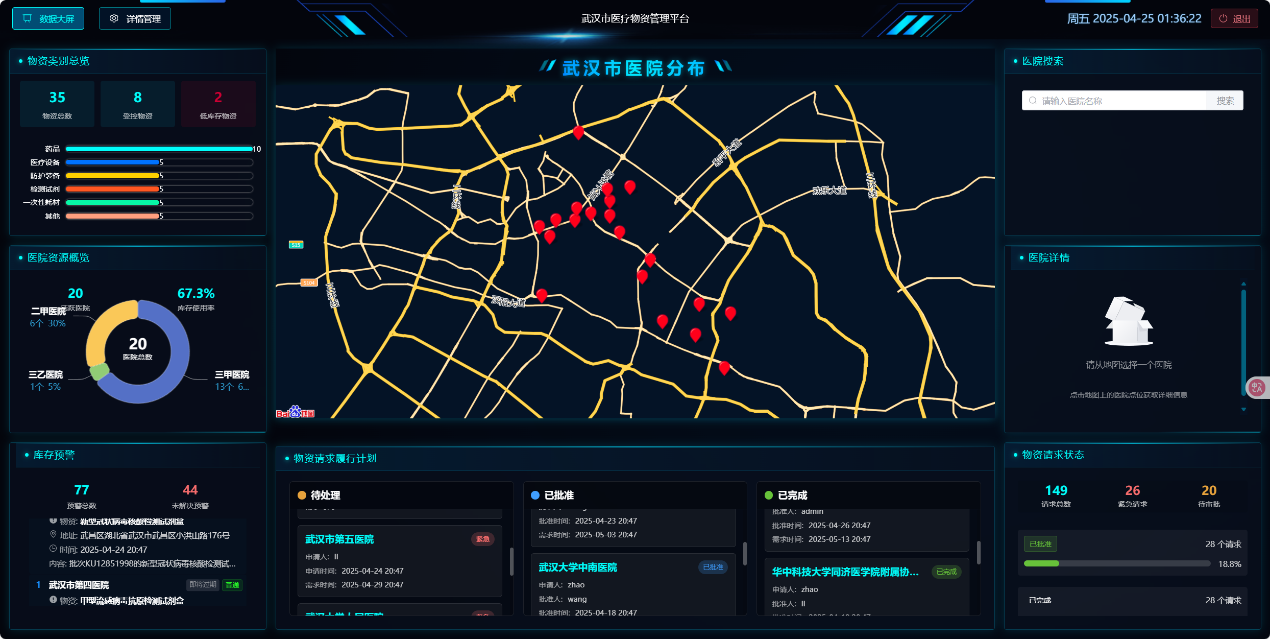
Relief supply allocation connects demand, inventory, request review, and distribution priorities. I developed a web platform that represents these processes as linked data and services, alongside a multi-criteria analysis of allocation priority.
My contribution
- Led the platform project and designed a decoupled browser–server architecture.
- Developed the frontend with Vue 3 and TypeScript and backend services with Django and Django REST Framework.
- Implemented frontend–backend communication through HTTP/REST APIs and integrated MySQL and GIS for persistent and spatial data management.
Technical approach
- Model hospitals, suppliers, medical supplies, inventory batches, requests, and fulfillment records as related entities. Track requested and allocated quantities, with a database constraint preventing allocations above the requested amount.
- Provide REST endpoints for record management, request approval/rejection, and alert resolution. Build corresponding Vue views and dashboards for inventory alerts, fulfillment, and hospital distribution.
- Develop a separate entropy-weighted TOPSIS analysis for allocation priority. Normalize hospital level, stock gap, a shortage indicator, and remaining shelf life; derive data-dependent weights and rank candidates by distance to ideal solutions.
- Connect spatial presentation with backend coordinate conversion and hospital-map data. Keep the ranking experiment separate from the application workflow while evaluating how decision support can inform allocation.
Results & outcomes
- Delivered an application structure spanning operational records, request review, inventory alerts, and geographic dashboards, together with an allocation-priority analysis. The work connects full-stack implementation with multi-criteria decision modeling.
- The standalone TOPSIS analysis produces an interpretable priority ranking from multiple demand and inventory indicators, adding a quantitative decision-support component to the project.