Deep reinforcement learning in vision
A brief survey across visual tasks
A survey draft comparing reinforcement-learning formulations in landmark detection, object detection, tracking, and segmentation.
Survey author
Landmark detection · Tracking · Segmentation
Research question
Reinforcement learning plays different roles across vision tasks: searching for a landmark, refining a bounding box, controlling a camera, or selecting a segmentation prompt. I organized these applications around their decision processes to understand where sequential reasoning contributes to visual perception.
My contribution
- Authored a cross-task survey covering landmark detection, object detection, object tracking, and semantic segmentation.
- Compared state representations, action spaces, rewards, and the interface between perception backbones and decision policies.
- Developed a critical analysis of visual context in state design, geometric versus semantic rewards, and the role of temporal information.
Technical approach
- Analyze hierarchical landmark search and multi-agent coordination through the actions and feedback used to localize targets.
- Compare bounding-box refinement, adaptive resolution, and patch selection as ways to allocate computation during detection.
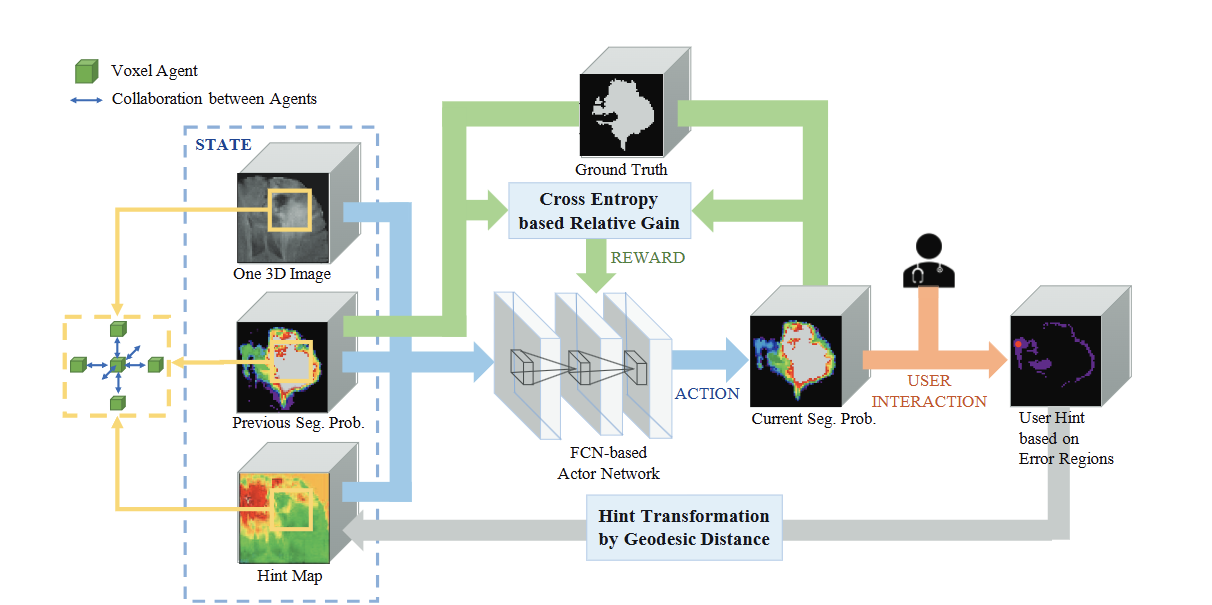
- Distinguish active camera control from passive tracking, then examine interactive segmentation, mask refinement, and automated prompt selection.
Results & outcomes
- Produced a structured survey connecting individual methods through a common state–action–reward analysis.
- The synthesis distinguishes direct visual decision-making from policies that guide search, allocate computation, or refine another model’s output, providing a foundation for my subsequent work at the intersection of perception and reinforcement learning.
My analysis: what does the policy actually learn?
I compare methods through the information available to the agent, not only their RL algorithm. In landmark search, coordinate- or distance-driven states and rewards raise a question: where does the policy obtain visual context? In detection, region features and action history make this interface more explicit.
I distinguish policies that predict visual outputs from policies that allocate computation or refine an existing model. Adaptive resolution, region selection, and bounding-box adjustment each optimize a different part of the perception pipeline.
For tracking, the key distinction is whether the action changes the camera or only the estimated target box; this determines what the environment transition means. In segmentation, click selection and mask refinement reveal how prior predictions can become state information for the next decision.