Heliostat-field layout optimization
Solar-energy modeling in CUMCM
2023 · CUMCM
Modeling optical efficiency and optimizing heliostat layouts; awarded National Second Prize in the 2023 undergraduate modeling contest.
Team participant
Monte Carlo · Ray tracing · Simulated annealing
Research question
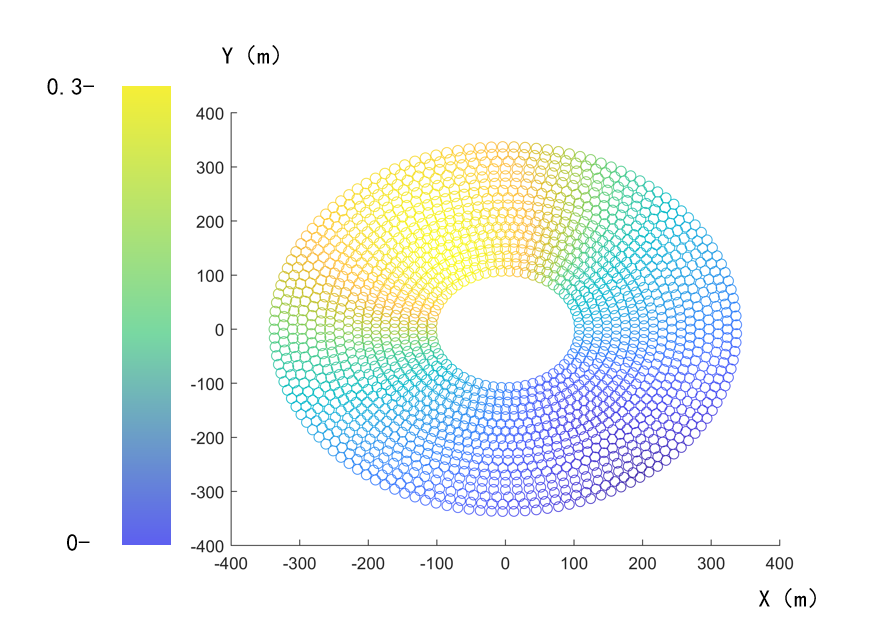
Heliostat-field design connects geometric optics with a large layout search space. Our team modeled how sunlight reaches the receiver and used thermal output per unit mirror area as the objective for selecting field geometry and mirror parameters.
My contribution
- Participated in the national mathematical-modeling team project on solar-field efficiency and layout design.
- The team study connected optical-efficiency calculations with parameterized layouts, addressing both uniform and ring-dependent mirror configurations.
Technical approach
- Establish field and mirror coordinate systems, calculate solar direction and mirror orientation, and express reflection and intersection tests geometrically.
- Use Monte Carlo ray tracing to estimate shadowing, blocking, and receiver interception, combining these terms with cosine efficiency, atmospheric transmission, and reflectivity.
- Parameterize a radial staggered layout and apply simulated annealing to mirror dimensions, installation heights, and field arrangement; extend the design to ring-dependent configurations.
Results & outcomes
- Awarded National Second Prize in the 2023 China Undergraduate Mathematical Contest in Modeling.
- The project connects solar geometry, stochastic simulation, and numerical optimization in one engineering model, with a technical report detailing the efficiency calculation and layout-design process.
From ray geometry to layout search
The model separates mirror geometry, ray validity, and field optimization. Coordinate transformations express mirror corners and light rays in a common frame. Ray–plane intersections and an area-based inside-rectangle test determine whether neighboring mirrors block an incoming or reflected ray.
Sampling mirror-surface points and tracing rays within a solar cone gives an estimate of the proportion of valid rays. Receiver interception is evaluated after successful reflection, separating blocking from truncation losses.
The layout search starts from a radial staggered parameterization rather than treating every mirror coordinate as independent. The extended configuration assigns dimensions and heights by concentric ring, including an inner-low/outer-high strategy. This structures the search around optical behavior while reducing the number of free variables.
